
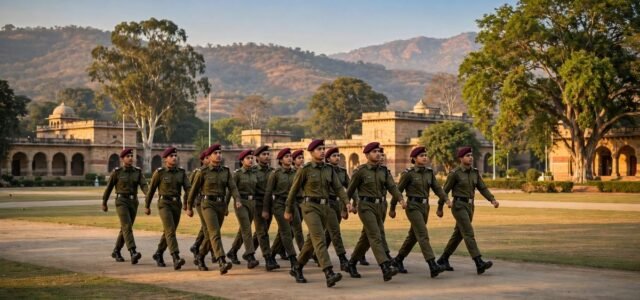
The National Defence Academy (NDA) is the dream destination for lakhs of young Indians who want to become officers in the Indian Army, Navy or Air Force. Conducted twice a year by the Union Public Service Commission, the NDA exam is open to 12th-pass students, and it is one of the few officer-level entries where you can join right after school. This guide explains the complete selection process — written exam, SSB interview, medical test — and a practical preparation plan for beginners.
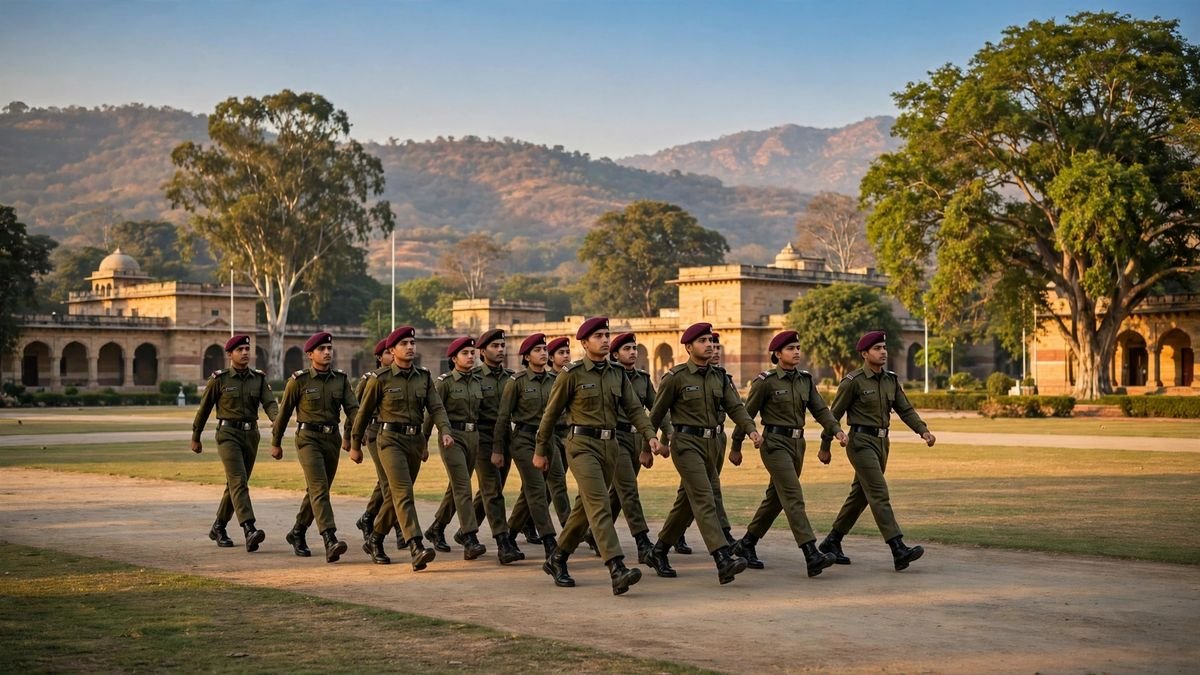
NDA selection is different from other government exams because it tests not only knowledge but also personality, leadership and physical fitness. The written exam checks mathematics and general ability, the SSB interview checks officer-like qualities over five days, and the medical test checks your fitness for military life. A beginner who starts preparation in class 11 or 12 has a strong advantage, but even a dedicated six-month plan can work if followed seriously.
Who Can Apply: Eligibility Criteria
Unmarried male and female candidates can apply for NDA. For the Army wing, candidates must have passed class 12 from a recognised board. For the Air Force and Naval wings, candidates must have passed class 12 with Physics and Mathematics. Candidates appearing in class 12 can also apply, provided they submit proof of passing before joining the academy. The age limit is 16.5 to 19.5 years at the time of joining the course, and the exact date range is given in each notification. There is no age relaxation for any category in NDA. Candidates must be Indian citizens, or meet the nationality conditions given in the official notification.
NDA Written Exam Pattern
The written exam has two papers. Paper 1 is Mathematics of 300 marks with 120 questions, and the time allowed is 2 hours 30 minutes. Paper 2 is the General Ability Test of 600 marks with 150 questions, and the time allowed is also 2 hours 30 minutes. The General Ability Test is divided into English with 200 marks and General Knowledge with 400 marks. There is negative marking: one-third of the marks assigned to a question is deducted for a wrong answer. The total written exam is of 900 marks, and the SSB interview carries another 900 marks, making the final merit out of 1800 marks.
Subject-Wise Syllabus Explained
Mathematics covers algebra, matrices and determinants, trigonometry, analytical geometry of two and three dimensions, differential calculus, integral calculus and differential equations, vector algebra, statistics and probability — all based on class 11 and 12 NCERT books. The English section tests grammar and usage, vocabulary, comprehension and cohesion. General Knowledge covers physics, chemistry, general science, history, geography and current events. Physics includes motion, laws of motion, work and energy, heat, light, electricity and magnetism. Chemistry covers physical and chemical changes, elements, acids and bases, and everyday chemistry. History covers Indian freedom struggle and the Constitution, while geography covers the earth, rivers, climate, natural resources and Indian agriculture. Current events of the last six months are important, especially defence-related news.
6-Month Step-by-Step Study Plan
Month one and two are for mathematics: finish NCERT maths of classes 11 and 12 chapter by chapter, solving every exercise and example. Month three is for English and general science: read NCERT science books, practise grammar daily and start a newspaper for current affairs. Month four is for history, geography and polity from NCERT books and one standard GK book. Month five is for mock tests: take one full-length NDA mock test every week and revise weak chapters. Month six is for final revision: solve previous ten years of question papers, revise all formulas in a short notebook, and practise English comprehension daily. Alongside studies, run and exercise every morning, because physical fitness is tested in the SSB and the medical examination.

SSB Interview: The 5-Day Process
Candidates who qualify in the written exam are called for the Services Selection Board interview, which lasts five days. Day one is screening with intelligence tests and a picture perception test. Day two is psychological testing, including thematic apperception, word association, situation reaction and self-description tests. Days three and four are group testing with group discussions, group planning, outdoor tasks, command tasks and individual obstacles. Day five is the personal interview and the final conference. The SSB does not look for toppers; it looks for officer-like qualities such as leadership, teamwork, communication, confidence and decision-making. Be honest, be yourself, and never try to copy answers from coaching books, because trained assessors can easily spot memorised responses.
Physical and Medical Standards
NDA candidates must meet strict medical standards. The minimum height is 157 cm for Army and 157 cm for Navy and Air Force with specific requirements, and the weight must be proportionate to height and age. Eyesight standards are strict, especially for the Air Force, where the vision requirement is 6/6 in one eye and 6/9 in the other without glasses for flying branch. Candidates must not have any major disease, and hearing, dental and general physical health are checked in detail. Keep your body fit, eat well, and get a basic medical check-up done before applying so that any correctable problem can be treated in time. You can see how results are announced in our report on the UPSC NDA result and marks page.
Mistakes to Avoid
The biggest mistake is preparing only for the written exam and ignoring the SSB interview, which carries equal marks. Another error is mugging up mathematics formulas without understanding the concepts, because NDA maths questions test application, not memory. Many candidates ignore English, forgetting that it carries 200 marks in the General Ability Test. Some students join expensive coaching without finishing NCERT books first, which is the real foundation of this exam. Others neglect physical fitness and fail the medical test after clearing everything else. Finally, never fake your personality in the SSB; the assessors are trained to detect it, and dishonesty is the fastest way to get rejected.
Frequently Asked Questions
What is the qualification for NDA? Class 12 pass is required. For Air Force and Navy wings, Physics and Mathematics in class 12 are compulsory. Appearing candidates can also apply.
What is the age limit for NDA? Candidates must be between 16.5 and 19.5 years of age. There is no age relaxation for any category.
How many marks is the NDA written exam? The written exam is of 900 marks — Mathematics 300 marks and General Ability Test 600 marks. The SSB interview carries another 900 marks.
Can girls apply for NDA? Yes, unmarried female candidates can apply for NDA since 2021, for all three wings of the armed forces.
Is there negative marking in NDA? Yes, one-third of the marks of a question are deducted for every wrong answer in both papers.
How should I prepare for the SSB interview? Build officer-like qualities through group activities, sports, reading newspapers and honest self-assessment. Practise group discussions and psychological tests with genuine answers, not memorised ones.
Quick Checklist Before You Start
- Check your age, class 12 subjects and marital status against the notification.
- Finish NCERT maths and science books of classes 11 and 12.
- Read a newspaper daily and note defence-related news.
- Solve previous ten years of NDA question papers.
- Exercise daily and get a basic medical check-up done.
- Prepare for the SSB interview from the first month itself.
NDA is not just an exam; it is the first step towards a life of honour, discipline and service to the nation. The preparation is tough, but the reward is a career that few jobs can match. Start with NCERT books, stay consistent, and keep your fitness and personality in shape. For defence-related updates, also read our Indian Army TES recruitment and Air Force AFCAT recruitment pages on this site.

